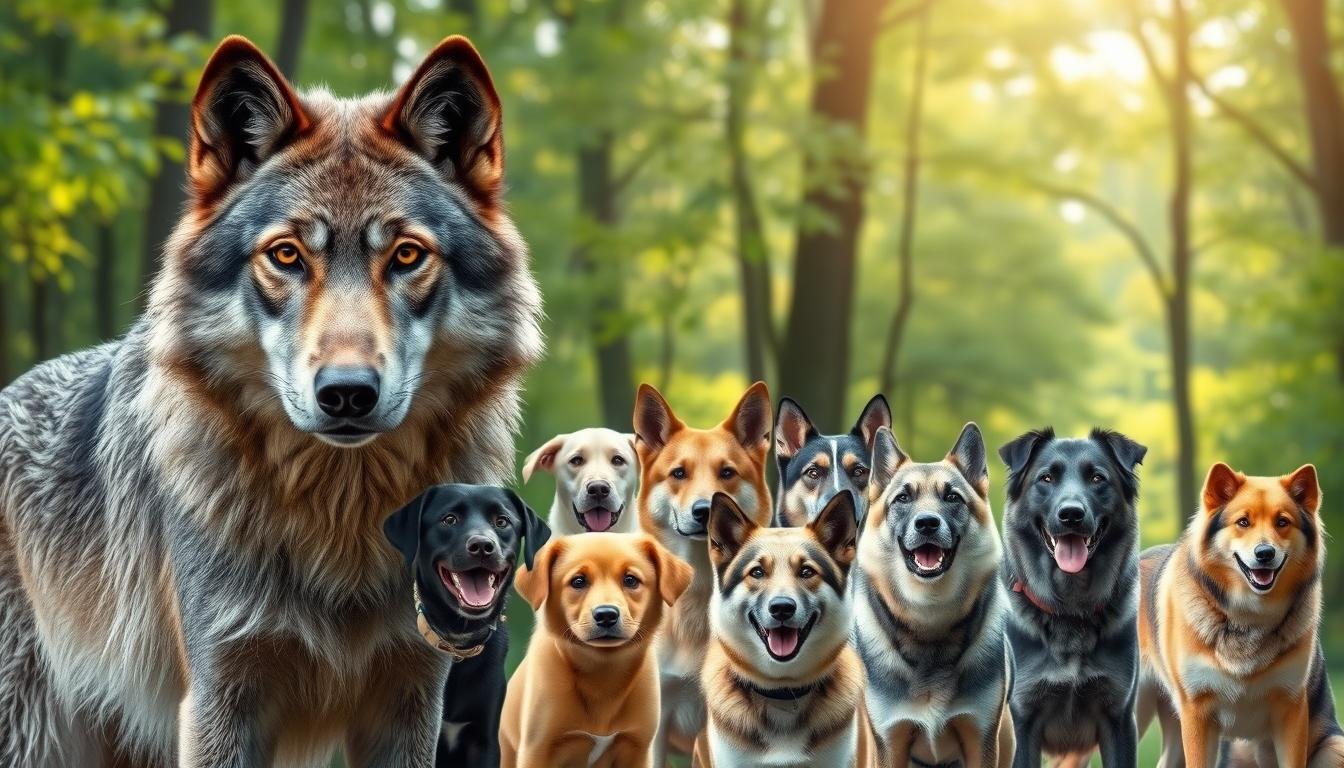
The Canidae family has 35 diverse species. These include wild dogs, wolves, foxes, and jackals. They play vital roles in ecosystems all over the world.
It’s important to understand the canine species. This helps us see their value in nature and their connection to humans.
This guide gives an overview of the different species in the Canidae family. It highlights their unique traits.
Key Takeaways
- The Canidae family includes 35 species.
- These species play vital roles in ecosystems.
- Understanding canine species is important for appreciating their role in nature.
- The guide covers key species and their traits.
- Learning about these animals enhances our appreciation for biodiversity.
Understanding the Canidae Family
Members of the Canidae family are known for their ability to adapt and thrive in different environments. This family, part of the Carnivora order, includes wolves, foxes, jackals, and domestic dogs. Their diversity is impressive.
Taxonomy and Classification
The Canidae family falls under the Carnivora order. Their taxonomy is complex due to the wide range of species within it. Canids are split into several genera, with Canis being one of the most well-known. It includes wolves and domestic dogs.
- The genus Canis includes wolves, dogs, and jackals.
- The genus Vulpes comprises various fox species.
- Other genera include Lycaon for African wild dogs and Cuon for dholes.
Evolutionary History
The Canidae family’s evolutionary history goes back to the Eocene epoch. Fossil records show a variety of species over time. Their evolution is marked by adaptations to different habitats and prey, making them successful predators.
Key evolutionary milestones include:
- Development of specialized hunting behaviors.
- Adaptation to different climates and prey.
- Evolution of complex social structures in some species.
Common Characteristics of Canids
Canids, despite their diversity, share common traits. They are carnivorous, have sharp teeth, and a keen sense of smell. These traits help them thrive in various environments, from dense forests to open tundras.
Some common characteristics include:
- Sharp, pointed teeth for meat consumption.
- A highly developed sense of smell for hunting and tracking.
- Adaptability to different habitats and prey.
Complete Dog Family Animals List
The dog family includes many wild canids and domestic dog breeds. This group is very interesting and important. It includes wolves, foxes, jackals, and many domesticated breeds that have evolved over centuries.
Wild Canid Species
There are 35 species of wild canids. Each has its own unique traits and habitats. Some well-known wild canids are:
- Gray Wolf: Gray wolves live in forests and tundras. They are adaptable and social.
- Red Fox: Red foxes are known for their cunning and agility. They are found across the Northern Hemisphere.
- Arctic Fox: Arctic foxes live in the Arctic tundra. They have thick fur and a circumpolar distribution.
- Jackal: Jackals are medium-sized canids. They live in deserts and forests worldwide.
Domestic Dog Categories
Domestic dogs come in a wide range of breeds. They are categorized by their original purpose, size, and characteristics. The main categories are:
- Sporting Dogs: Sporting dogs are energetic and love water. They are great for active families.
- Herding Dogs: Herding dogs are intelligent and can herd animals. They are easy to train.
- Working Dogs: Working dogs are strong and capable. They are used for guarding, search and rescue, and more.
- Companion Dogs: Companion dogs are friendly and outgoing. They make excellent family pets.
Conservation Status in North America
The conservation status of canids in North America varies. Some, like the gray wolf, have recovered in some areas. Others are endangered.
- Gray Wolf: Gray wolves were once endangered. Conservation efforts have helped them recover in some places.
- Red Wolf: The red wolf is critically endangered. Conservation efforts are ongoing to save it.
- Mexican Gray Wolf: The Mexican gray wolf is also endangered. Reintroduction programs aim to increase its population.
Conservation efforts are key for many canid species. Supporting organizations that protect habitats and fight threats like poaching is vital.
Wild Canids of North America
North America is home to many wild canid species. Each has its own special traits and ways of living. These animals are key to their ecosystems, adding to the continent’s rich variety of life.
Gray Wolves and Their Recovery
Gray wolves were once almost gone from North America. But thanks to hard work in conservation, they’re back. Things like protecting their homes, bringing them back to places they used to be, and laws to help them have all played a part.
- Bringing wolves back to places like Yellowstone has helped their numbers grow.
- Laws like the Endangered Species Act have been very important for their comeback.
- Protecting their homes lets wolves roam freely in certain areas.
Coyote Adaptations to Urban Environments
Coyotes have learned to live well in cities. They’ve changed how they eat and act to fit in with city life. This flexibility has helped them thrive in urban areas.
- They’ve learned to eat things like garbage and pets.
- They’ve changed when and how they move to stay out of trouble with people.
- Coyotes make use of city parks and green spaces as their homes.
Red and Gray Fox Identification
Red and gray foxes are common in North America. They look and act differently from each other.
Physical Characteristics
Red foxes have bright orange fur. Gray foxes have a gray coat with a black-tipped tail. Size and ear shape also help tell them apart.
Red foxes like to be alone and are found all over North America. Gray foxes are more flexible in where they live and are good at climbing trees.
- Red foxes are mostly active at night and eat a variety of things.
- Gray foxes eat both plants and animals and often live in underground burrows.
Wolves: The Ancestors of Domestic Dogs
Gray wolves are the ancestors of domestic dogs. They give us insights into their behavior, social structure, and conservation. Studying them helps us understand these amazing creatures better. It also guides us in managing dog populations.
Gray Wolf Behavior and Social Structure
Gray wolves are very social and live in complex family groups. A pack usually has a breeding pair and their kids. The pack has a strict hierarchy, with the alpha pair leading.
This structure is key for their survival. It helps with hunting, defending territory, and caring for young ones.
Key aspects of gray wolf behavior include:
- They hunt together, taking down prey bigger than themselves.
- They mark and defend their territory to keep their pack together and warn off rivals.
- They have complex ways of communicating, like howling, barking, growling, body language, and scent marking.
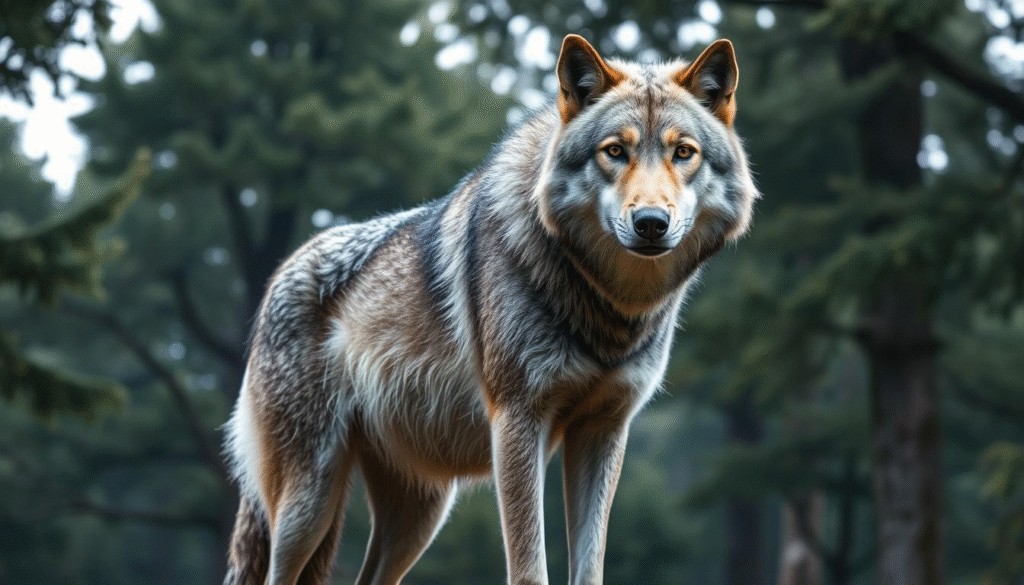
How to Identify Wolf Signs in the Wild
Finding wolf signs in the wild is exciting for wildlife lovers. Look for:
- Tracks: Wolf tracks are bigger than dog tracks, about 3.5 to 4.5 inches long. They’re found in soft ground like mud or snow.
- Scat: Wolf scat is bigger and more segmented than dog scat. It has bits of their diet in it.
- Howling: While not a physical sign, wolf howling is a unique sound. Responding to howls might get a reaction from nearby wolves.
Wolf conservation in the U.S. is complex. It involves legal protections, saving their habitats, and reducing conflicts with humans. The Endangered Species Act (ESA) has helped protect gray wolves. But, their status changes by region, with some not protected anymore.
Conservation efforts include:
- Protecting and restoring their habitats.
- Studying wolf ecology and behavior to improve management.
- Education and outreach to lessen human-wolf conflicts.
Supporting these efforts helps ensure gray wolves can thrive in their natural habitats.
How to Identify Common Fox Species
North America has many fox species, like red, gray, kit, and swift foxes. Each has its own look. Knowing these differences is important for wildlife fans and anyone interested in dogs and their relatives.
Red Fox Recognition Guide
Red foxes are found all over North America. They have reddish-orange fur and white bellies. Their bushy tails end in white, and their ears are long and black.
They can live in many places, from farms to cities.
Wildlife experts say, “Red foxes are very flexible and live in forests, grasslands, and cities.” Their ability to adapt makes them common in many areas.
Gray Fox Distinctive Features
Gray foxes are less common than red foxes but easy to spot. They have gray fur and a black-tipped tail. They can climb trees, a rare skill among foxes.
Kit and Swift Fox Identification
Kit and swift foxes are smaller than others. Kit foxes have big ears and sandy-brown fur. Swift foxes are grayish-brown with bushy tails. Both live in dry, open places.
Habitat Preferences
Each fox species likes different places to live. Red foxes can be found in forests, grasslands, and cities. Gray foxes like dense forests and woodlands. Kit and swift foxes prefer dry areas and grasslands.
- Red foxes: Forests, grasslands, urban areas
- Gray foxes: Dense forests, woodlands
- Kit foxes: Arid regions, grasslands
- Swift foxes: Grasslands, open areas
Behavioral Patterns
Each fox species acts differently. Red foxes are smart and can be seen in cities looking for food. Gray foxes are alone and hard to find.
“Foxes are generally solitary animals, with some species being more territorial than others. Understanding their behavior is key to identifying them in the wild.”
From Wild to Domestic: The Evolution of Dogs
Dogs evolved from gray wolves through domestication. This change shows how adaptable these animals are and how close they’ve become to humans.
Step-by-Step Domestication Timeline
Dogs were domesticated between 15,000 to 30,000 years ago. The exact time is a topic of ongoing research. It started when wolves visited human camps for food.
- Initial Contact: Wolves began visiting human camps.
- Adaptation: Over time, certain wolves adapted to human presence.
- Domestication: Humans may have actively encouraged the presence of these more docile wolves.
- Selective Breeding: As humans and dogs spent more time together, selective breeding began for desired traits.
Key Genetic Changes
Genetic studies have found changes in dogs during domestication. These changes affected their behavior, physiology, and looks.
| Genetic Change | Effect |
| Behavioral Genes | Reduced aggression, increased docility |
| Dietary Adaptations | Ability to digest human food, including starch |
| Physical Traits | Variety in size, coat, and ear types |
How Wolves Became Man’s Best Friend
The change from wolves to domesticated dogs was slow. It involved natural changes and human help. Dogs became important to humans, helping in many ways.
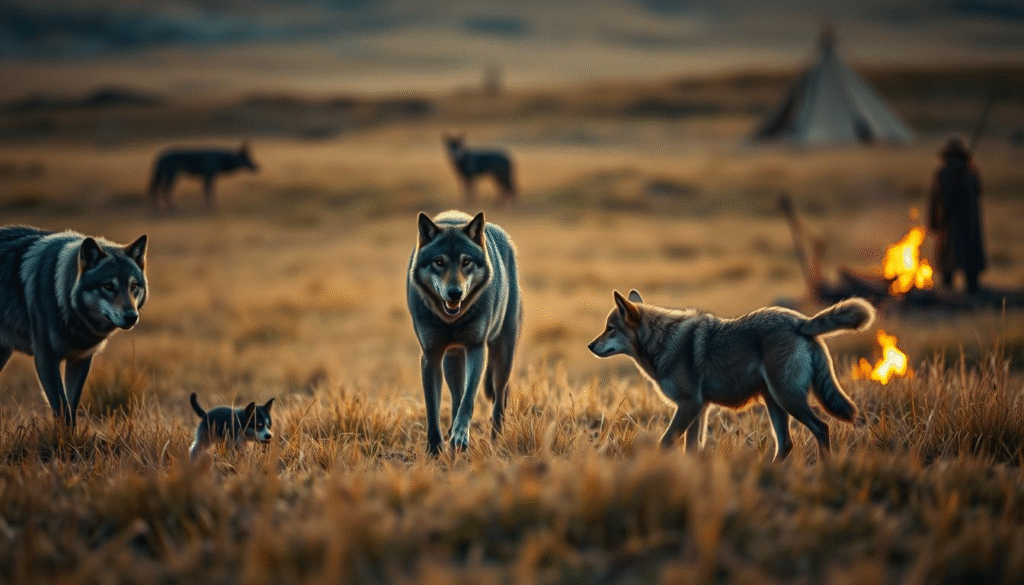
The bond between humans and dogs has grown stronger. Today, dogs are more than pets. They are family members, bringing joy and love to our lives.
How to Choose the Right Dog Breed for Your Family
Choosing the right dog breed means looking at your home, exercise habits, and family needs. With so many breeds out there, it’s key to think about several things to find the best dog for you.
Step 1: Assess Your Lifestyle and Living Situation
Before getting a dog, check your lifestyle and home. Think about your home’s size, yard, and daily routine. For example, a big, energetic dog might not fit in a small apartment.
Key considerations include:
- Space available at home
- Your daily routine and how it impacts your ability to care for a dog
- Allergies or sensitivities within the household
Step 2: Determine Exercise and Space Requirements
Dogs need different amounts of exercise. Some need lots of activity, while others are happy with short walks. Also, think about the space your dog will have to play and relax.
| Breed Size | Exercise Needs | Space Requirements |
| Small | Low to Moderate | Small to Medium |
| Medium | Moderate | Medium to Large |
| Large | High | Large |
Step 3: Consider Temperament and Trainability
A dog’s personality and how easy it is to train are very important. Some breeds are harder to train, and some are better with kids.
“The right dog breed for your family is one that not only fits your lifestyle but also brings joy and companionship to your household.”
When looking at a breed’s personality, think about:
- Energy level and how it matches your family’s activity level
- Compatibility with children, if applicable
- Potential for training and obedience
Step 4: Evaluate Health and Longevity Factors
Different breeds face different health problems. Knowing this can help you prepare for vet bills and make a smart choice.
Looking into common health issues and lifespan of your chosen breed can help you make a better choice.
Popular American Dog Breeds and Their Characteristics
From working dogs to beloved family pets, American dog breeds show a wide range of traits and abilities. These breeds have been developed over centuries for various purposes. They serve as assistance, companions, hunters, and sports dogs.
Working and Service Dogs
Working and service dogs are bred for their strength, intelligence, and task-specific abilities. Breeds like the German Shepherd and Labrador Retriever are often used as service dogs. They are known for their trainability and loyalty.
These dogs help individuals with disabilities, providing essential support in daily life.
| Breed | Primary Use | Characteristics |
| German Shepherd | Service, Protection | Intelligent, Loyal, Courageous |
| Labrador Retriever | Service, Assistance | Friendly, Outgoing, Trainable |
| Doberman Pinscher | Guarding, Protection | Loyal, Alert, Athletic |
Family-Friendly Companion Breeds
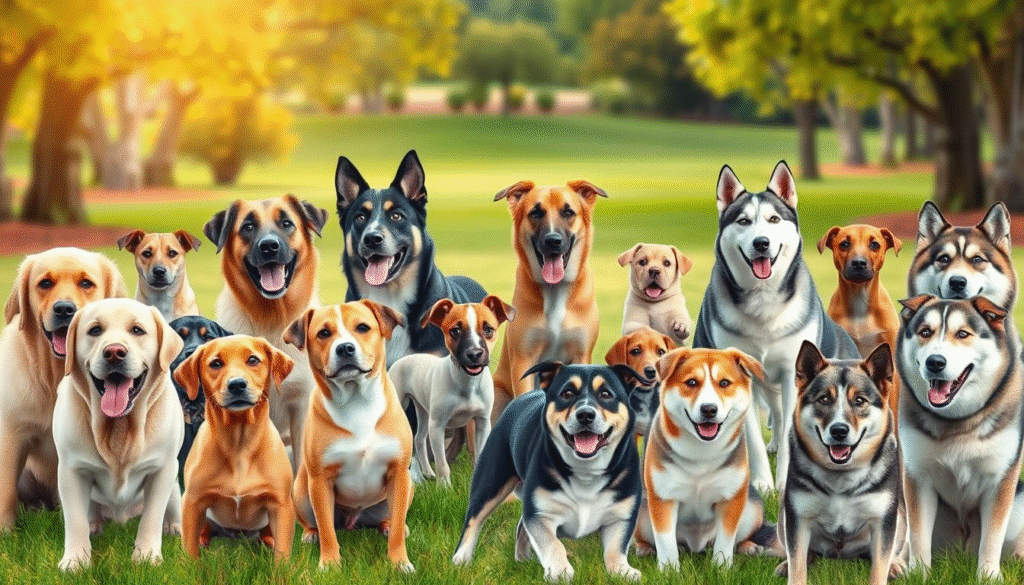
Family-friendly dog breeds are known for their gentle nature and ability to fit into family life. Breeds like the Golden Retriever and Beagle are popular for families. They are friendly and affectionate.
Sporting and Hunting Dogs
Sporting and hunting dog breeds are bred for their energy, agility, and strong prey drive. They excel in dog sports and hunting. The English Springer Spaniel and Pointer are examples of breeds that thrive in these roles.
Field Trial Champions
Breeds like the English Setter and German Shorthaired Pointer compete in field trials. They show their hunting prowess and trainability.
Versatile Hunting Companions
Versatile hunting breeds can perform multiple tasks, from flushing game to retrieving. The Chesapeake Bay Retriever is a prime example. It is known for its versatility and endurance in hunting environments.
How to Safely Observe Wild Canids in Nature
To safely watch wild canids in their natural home, you need to know their habitats and behaviors. This knowledge makes the experience better and keeps everyone safe.
Finding Prime Viewing Locations
Finding the best spots to see wild canids is key. They live in many places, like forests and grasslands. Look for areas known for canid sightings, like national parks or wildlife reserves.
National parks and wildlife reserves offer guided tours and special viewing spots. These help you see the animals without disturbing them.
Best Practices for Wildlife Observation
When watching wild canids, follow important rules to protect them. Keep a safe distance. Using binoculars or spotting scopes lets you see them up close without bothering them.
Be aware of your surroundings and keep quiet. This helps avoid scaring the animals. Waiting quietly can lead to closer and more interesting views.
Photography Tips and Equipment
If you want to take photos, a good camera with a zoom lens is essential. It lets you take clear pictures from far away, without disturbing the animals.
Understanding the canids’ behavior helps you capture special moments. This could be when they hunt or interact with each other.
Respecting Wildlife Boundaries
It’s important to respect the space of wild canids. Don’t feed them, as it can change their natural behavior. It also makes them rely on humans.
Also, remember to stay safe and keep others in your group safe. Always keep a safe distance from the canids.
Conservation Efforts for Endangered Canids
Endangered canids like red wolves and Mexican gray wolves need urgent help. They are key to their ecosystems. Losing them could harm the environment a lot.
Red Wolf Recovery Program
The Red Wolf Recovery Program aims to save the red wolf in the wild. It includes breeding in captivity, releasing wolves, and watching them in the wild.
Key aspects of the Red Wolf Recovery Program include:
- Captive breeding programs to increase population numbers
- Reintroduction of captive-bred wolves into the wild
- Monitoring and management of released wolves to ensure their survival
Mexican Gray Wolf Reintroduction
The Mexican Gray Wolf Reintroduction program is vital. It aims to bring back a healthy Mexican gray wolf population to their natural habitats.
Reintroduction efforts involve:
- Release of captive-bred wolves into designated wilderness areas
- Tracking and monitoring of released wolves to assess their adaptation and survival
- Community engagement and education to promote coexistence with wolves
How to Support Canid Conservation
There are many ways to help canid conservation. You can volunteer or donate to support these efforts.
Volunteer Opportunities
Volunteering is a great way to help. Many groups offer chances to help with fieldwork. You can monitor wolf populations, help at conservation centers, or do community outreach.
Donation Programs
Donations are key for funding conservation projects. Supporting groups focused on canid conservation can really help their work.
| Conservation Organization | Focus Area | Donation Impact |
| Red Wolf Recovery Program | Captive breeding and reintroduction | Funds release of more wolves into the wild |
| Mexican Gray Wolf Initiative | Reintroduction and monitoring | Supports tracking and community engagement |

Conclusion
The canine family, including wolves, foxes, and domestic dogs, is a rich tapestry of animal companions. We’ve looked at the diverse range of species in the Canidae family. This includes wild canids like gray wolves and red foxes, and the many domestic dog breeds that are part of many families in North America.
It’s important to understand the taxonomy, evolutionary history, and common traits of canids. This knowledge helps us appreciate their role in our ecosystems and lives. The dog family animals list is more than just a catalog of species. It shows the complex interactions between humans, domestic animals, and wildlife.
“The more we learn about the natural world, the more we realize how interconnected we are with the creatures that share our planet.” This quote highlights the need for conservation efforts to protect endangered canid species.
Conservation is key to preserving the canine family. Efforts to recover red wolf populations and reintroduce Mexican gray wolves are important. These steps help maintain biodiversity. Supporting these programs is essential for the long-term survival of these magnificent creatures.
As we end this guide, it’s clear that the dog family is more than just different species. It’s a vibrant community that makes our world richer. By learning more about and protecting these animal companions, we can work towards a future where humans and canids thrive together.
| Canid Group | Examples | Conservation Status |
| Wild Canids | Gray wolves, Red foxes | Varies by species |
| Domestic Dogs | Various breeds | Domesticated, not considered endangered |
| Endangered Canids | Red wolves, Mexican gray wolves | Endangered |
Sources
This guide’s information comes from trusted sources. These include wildlife conservation groups and scientific studies.
For more on the Canidae family and their conservation, check out these resources:
IUCN Red List – A detailed database on species conservation, including canids.
The Wolf Conservation Center – A place focused on saving wolves.
Defenders of Wildlife – A group working to protect wild animals and their homes.
These sources offer deep insights into canids and the work to save them.
FAQ
What is the Canidae family?
The Canidae family, also known as canids, includes dogs, wolves, foxes, and other related species. They are carnivorous mammals found worldwide.
What are some common characteristics of canids?
Canids are known for their meat-eating diet and sharp teeth. They also have a strong sense of smell. They adapt well to different environments.
How many species of wild canids are there?
There are many wild canid species, like gray wolves and coyotes. The exact number depends on the classification system used.
What is the conservation status of canids in North America?
In North America, canid conservation status varies by species. Some, like gray wolves, are endangered. Others, like coyotes, are not.
How can I identify a gray wolf?
Gray wolves have gray fur, sharp teeth, and piercing eyes. They are known for howling and roaming long distances.
What are some popular dog breeds in the United States?
In the United States, popular dog breeds include German Shepherds and Labradors. Golden Retrievers and Beagles are also favorites.
How can I choose the right dog breed for my family?
Choosing the right dog breed involves considering your lifestyle and exercise needs. Research different breeds to find the best fit for your family.
How can I safely observe wild canids?
To safely observe wild canids, keep a safe distance. Use binoculars or a camera with a telephoto lens. Avoid disturbing their natural behavior.
How can I support canid conservation efforts?
You can support canid conservation by donating to reputable organizations. Volunteer for conservation projects. Spread awareness about protecting canid populations and habitats.
What are some ways to help protect endangered canids?
To protect endangered canids, support conservation programs like the Red Wolf Recovery Program. Advocate for policies that protect their habitats and prevent conflicts.